The Night an Entire Country Stopped What It Was Doing to Listen to a Boxing Match
The Night an Entire Country Stopped What It Was Doing to Listen to a Boxing Match
It was a Wednesday night in June. No television. No social media. No second screen. And yet, by the most reliable estimates, somewhere between 70 and 100 million Americans — out of a total population of about 130 million — were tuned to the same radio broadcast at the same moment, listening to the same fight.
Joe Louis versus Max Schmeling, June 22, 1938. It lasted two minutes and four seconds. Louis knocked Schmeling down three times before the German's corner threw in the towel. And in that brief window of time, something happened that simply cannot happen anymore — an entire country, or close enough to it, shared one single moment of collective experience.
Understanding why that was possible then, and why it's impossible now, tells you something important about what America lost when the media landscape exploded into a thousand fragments.
More Than a Fight
To appreciate the weight of that night, you have to understand what the bout represented beyond boxing. Schmeling had beaten Louis two years earlier in a stunning upset, and Nazi Germany had embraced the victory as evidence of Aryan racial superiority. The symbolism was explicit and ugly. By 1938, with Hitler's ambitions increasingly obvious to the world, the rematch had become something far larger than a heavyweight title fight.
Louis — the son of Alabama sharecroppers, a Black man competing in an America still brutally defined by segregation — carried the weight of a nation on his shoulders. President Roosevelt had invited him to the White House before the fight and told him the country needed his muscles. Black communities across America gathered around radios in churches, bars, and living rooms. White Americans listened too, many of them for reasons that had as much to do with geopolitics as with sports.
When Louis dismantled Schmeling in that first round, the response was immediate and nationwide. People poured into the streets in Harlem. Celebrations broke out in cities across the country. The radio announcer's voice cracked under the weight of what he was describing.
This was a sporting event that carried the full freight of a cultural moment — and it could only work because everyone was watching the same thing at the same time.
The Architecture of Shared Attention
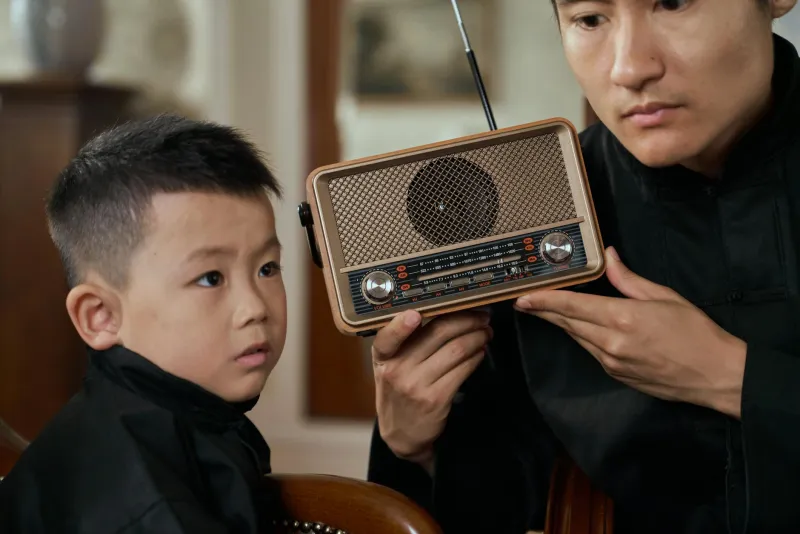
The media environment of 1938 was, by modern standards, extraordinarily simple. Radio was the dominant broadcast medium, and the major networks — NBC and CBS — commanded audiences that are genuinely staggering by today's standards. There was no competition from cable, no internet, no streaming platform offering something else entirely. If a major event was on the radio, America listened to it on the radio, because that was what there was.
This created something that media scholars sometimes call a "shared public sphere" — a common set of experiences that cut across class, geography, and even, to some extent, the racial divisions that defined American life. Not everyone experienced those shared moments equally. Black Americans listening to the Louis fight were doing so in a country that still denied them basic rights. But they were, at least, listening to the same broadcast.
The World Series operated the same way. In the 1950s, World Series games drew television ratings that are essentially unimaginable today — not because the games were better, but because there was nowhere else to go. You watched the Series or you watched nothing. That structural reality created a kind of cultural gravity that pulled everyone toward the same experience.
The Splintering
The fragmentation didn't happen overnight. Cable television in the 1980s was the first serious crack in the architecture. Suddenly there were dozens of channels, then hundreds. ESPN arrived and began siphoning sports away from the broadcast networks that had delivered unified national audiences. Pay-per-view moved boxing's biggest fights behind a financial wall that immediately shrank the potential audience.
The internet didn't just add more options — it fundamentally changed the relationship between audiences and media. Passive, scheduled viewing gave way to on-demand consumption. The idea of everyone watching the same thing at the same time started to feel almost quaint.
Today, the Super Bowl is the last genuine mass-audience television event in America. It regularly draws 100 million viewers or more, which sounds enormous — and is — but it exists in a landscape where those same viewers are simultaneously on their phones, browsing social media, texting friends, and dipping in and out of the experience in a way that is nothing like sitting in a darkened living room in 1938, leaning toward a radio, with nothing else competing for your attention.
And the Super Bowl is the exception. The World Series, once the defining shared sports moment in America, now draws audiences a fraction of its mid-century peaks. Game 7 of the 2016 Series — one of the most dramatic finishes in baseball history — drew about 40 million viewers. The 1978 Series drew similar numbers when the country had 100 million fewer people. The audience hasn't just shrunk. The cultural gravity that once made watching mandatory has essentially dissolved.
What Gets Lost
There's a temptation to be purely nostalgic about this — to mourn the loss of those unified moments as if fragmentation is simply bad. The reality is more complicated. The old media architecture that created shared national experiences also enforced a kind of cultural homogeneity that excluded as much as it included. The audiences for those early television spectacles were overwhelmingly white. The stories those broadcasts centered were overwhelmingly the stories of white America.
Fragmentation has, in some ways, allowed for more voices, more stories, more kinds of sports to find audiences. That's genuinely valuable.
But something was also lost. The Louis-Schmeling fight mattered partly because everyone knew it mattered — because the shared attention itself was part of the event's meaning. When 70 million people stop what they're doing to listen to the same two minutes, that act of collective focus becomes a kind of cultural statement. We are all here, together, for this.
No sporting event can make that statement anymore. The infrastructure for it no longer exists. We watch sports today in parallel, each of us on our own screen, in our own algorithm-curated feed, with a hundred other options one tap away.
Joe Louis knocked Max Schmeling down three times in two minutes, and a country heard it happen together. That specific kind of together — unrepeatable, undiluted, shared — belongs entirely to then, before this.