From Death Traps to Weekend Warriors: How America Learned to Run 26.2 Miles for Fun
When Running 26.2 Miles Was a Death Sentence
In 1904, at the St. Louis Olympics, the marathon wasn't a weekend hobby—it was a near-death experience. Felix Carvajal showed up in street clothes and leather shoes. Jan Mashiani collapsed from dehydration and was rushed to the hospital. Thomas Hicks, the eventual winner, was fed rat poison and brandy by his handlers to keep him upright. He nearly died crossing the finish line.
This wasn't an outlier. Early marathons were medical emergencies waiting to happen. Runners had no understanding of hydration, pacing, or proper nutrition. They ran in wool uniforms and heavy boots. Medical support was virtually nonexistent. Finishing was an act of pure survival.
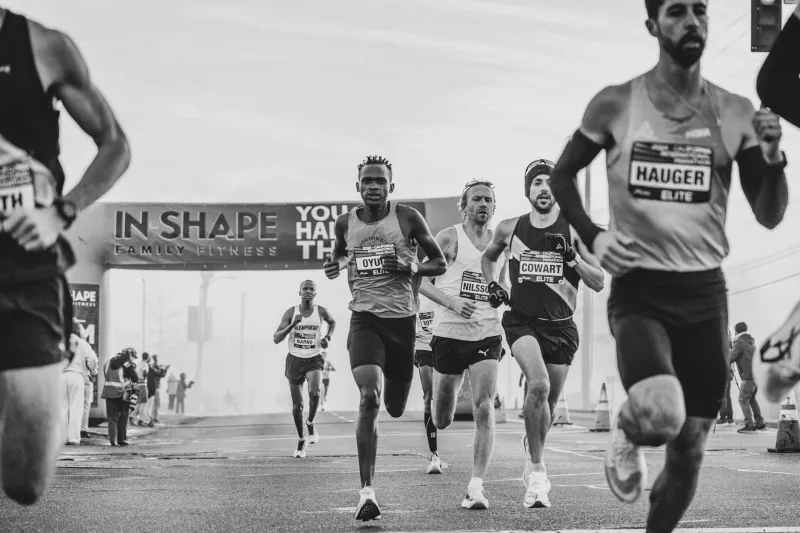
Fast-forward to last weekend, when 50,000 people lined up in Chicago to run the exact same distance—most of them smiling for selfies at the starting line.
The Science Revolution That Changed Everything
The transformation didn't happen overnight. For decades, running remained the domain of a small group of elite athletes who trained in isolation and competed in near-anonymity. The 1960s changed everything.
Suddenly, researchers began studying exercise physiology seriously. They discovered the importance of carbohydrate loading, proper hydration, and gradual training increases. The concept of "hitting the wall" went from mysterious phenomenon to understood metabolic process.
More importantly, they proved that ordinary people could safely complete marathons with proper preparation. This wasn't reserved for genetic freaks or professional athletes. Your accountant could do it. Your teacher could do it. Your neighbor definitely could do it.
When America Caught Running Fever
The 1970s running boom turned everything upside down. Frank Shorter's Olympic marathon victory in 1972 sparked something unprecedented: millions of Americans started running for recreation. Not to escape bears or catch buses—just because they wanted to.
The New York City Marathon, which started in 1970 with 127 runners doing loops in Central Park, exploded into a citywide celebration drawing participants from around the globe. Boston Marathon entries, once easily obtainable by any reasonably fit runner, became so competitive they required qualifying times.
Running stores appeared in suburban strip malls. Specialized shoes, clothing, and accessories created entire industries. What was once a niche sport practiced by a few hundred elite athletes became a mainstream lifestyle choice embraced by millions.
The Technology That Made It Accessible
Today's marathon experience would be unrecognizable to those early Olympic runners. GPS watches track every step, providing real-time feedback on pace, heart rate, and projected finish times. Runners consume scientifically formulated energy gels at precise intervals. Hydration stations appear every few miles, staffed by volunteers who understand exactly how much fluid the human body needs.
Smartphone apps guide training programs, adjusting weekly mileage based on performance and recovery metrics. Online communities provide support, advice, and motivation. Race registration happens with a few clicks, complete with corral assignments based on predicted finish times.
The physical infrastructure has transformed too. Modern marathons feature medical tents staffed with sports medicine specialists, not general practitioners hoping for the best. Course design considers everything from elevation changes to wind patterns. Timing chips provide split times accurate to the second.
The Democratization of Distance
Perhaps the most dramatic change is who runs marathons today. The 1904 Olympic marathon field consisted entirely of men, mostly professional athletes or serious amateurs. Today's major marathons are roughly 40% female, with participants ranging from teenagers to octogenarians.
The average marathon time has actually gotten slower as the sport expanded—not because people are less capable, but because finishing has become more important than winning for the vast majority of participants. The goal shifted from surviving the distance to enjoying the experience.
Charity fundraising transformed marathons into social movements. Runners don't just complete 26.2 miles; they raise millions for causes ranging from cancer research to disaster relief. The Boston Marathon bombing response demonstrated how deeply these events are woven into American culture.
From Spectacle to Lifestyle
Early marathons were curiosities, drawing small crowds of bewildered spectators watching what appeared to be voluntary torture. Today, major marathons shut down entire cities, drawing hundreds of thousands of cheering supporters who understand exactly what runners are experiencing.
The training culture has become almost as significant as the races themselves. Running groups meet in every American city, providing social connection alongside physical conditioning. Marathon training schedules are discussed at dinner parties. Completing 20-mile training runs becomes casual conversation topics.
What once required extraordinary physical gifts and borderline reckless determination now demands nothing more than patience, consistency, and a decent pair of running shoes. The marathon transformed from a test of human limits into a celebration of human potential.
The Weekend Warrior Reality
Today, over half a million Americans complete marathons annually. Many do multiple races per year. The distance that once hospitalized Olympic athletes is now tackled by people who work desk jobs and have never run competitively.
This isn't to diminish the achievement—26.2 miles remains a significant physical and mental challenge. But the infrastructure, knowledge, and culture now exist to make it safely accessible to anyone willing to train properly.
The marathon's evolution from death trap to weekend hobby reflects broader changes in how Americans approach physical challenges, health, and personal achievement. We've learned to make the extraordinary feel ordinary—and somehow, that makes it even more remarkable.