Empty Gyms and Fifty-Dollar Paychecks: When Basketball's Championship Was America's Best-Kept Secret
The Night Nobody Came
On April 22, 1947, the Philadelphia Warriors beat the Chicago Stags 83-80 to win the Basketball Association of America championship. The game was played at the Philadelphia Arena in front of 8,221 fans—a decent crowd by the standards of the day, but roughly the same number of people who now show up to watch a decent high school basketball game in Indiana.
 Photo: Philadelphia Warriors, via png.pngtree.com
 Photo: Philadelphia Arena, via images.squarespace-cdn.com
The Warriors' Joe Fulks, the series MVP, earned about $4,500 for the entire season. Adjusted for inflation, that's roughly $60,000 today—less than what a benchwarmer in the modern NBA makes in a single game. Most players worked summer jobs selling insurance or teaching physical education just to make ends meet.
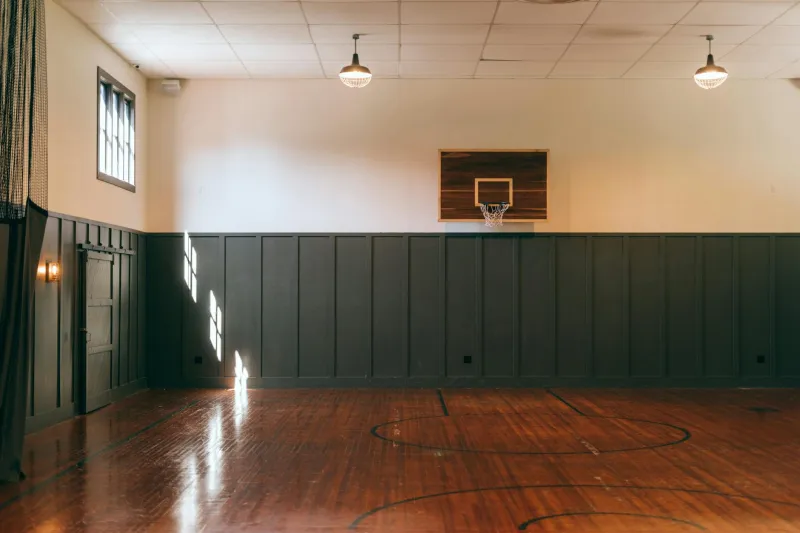
The arena itself would seem quaint by today's standards. No luxury suites, no corporate sponsors plastered on every surface, no halftime entertainment beyond a local marching band. Fans paid between 60 cents and $2.40 for tickets—the equivalent of $8 to $32 today. You could literally decide to attend the championship game on a whim and buy a ticket at the door.
When Championships Were Local Affairs
Those early basketball championships weren't even called the NBA Finals. The league was the Basketball Association of America, and it was competing with several other professional leagues for fans who weren't entirely sure professional basketball was worth watching. College basketball was more popular, and frankly, so were bowling tournaments.
The games received minimal newspaper coverage outside the cities where teams played. There was no national television broadcast—television itself was still a novelty that most Americans didn't own. Radio coverage was sporadic and regional. If you lived in Los Angeles and wanted to know how the championship series was going, you might find a brief score buried on the sports page next to the horse racing results.
Players often took public transportation to games. The idea of a team charter flight was absurd—commercial aviation was expensive and unreliable. Teams rode trains and buses, sharing cramped quarters and carrying their own equipment. The Warriors' championship celebration consisted of a team dinner at a local restaurant, not a parade through downtown Philadelphia.
The Transformation Begins
The shift toward today's spectacle happened gradually, then suddenly. Television changed everything, but it took decades. The first nationally televised NBA Finals game didn't happen until 1962, and even then, it was broadcast on a Saturday afternoon when most people were outside doing yard work.
The real turning point came in the 1980s when Magic Johnson and Larry Bird transformed professional basketball from a niche sport into must-see television. Suddenly, the Finals were appointment viewing. Corporate sponsors began paying serious money for advertising time. Arenas started building luxury boxes and charging premium prices.
By the 1990s, Michael Jordan had turned the NBA Finals into a global phenomenon. The 1998 Finals averaged 29.04 million viewers in the United States alone—more people than lived in the entire country when the Warriors won that first championship in 1947. International audiences added tens of millions more.
Today's Billion-Dollar Theater
A modern NBA Finals game is a production that would have seemed like science fiction to those early players and fans. The average ticket price for the 2023 Finals exceeded $1,500. Court-side seats regularly sell for $50,000 or more. The halftime show features Grammy-winning performers, and every timeout includes choreographed entertainment.
The television production employs hundreds of people and dozens of cameras, including some suspended from cables above the court and others that can zoom in close enough to count the sweat drops on a player's forehead. The broadcast reaches more than 200 countries and generates hundreds of millions in advertising revenue.
Players now earn more in a single playoff game than entire teams made in those early seasons. The minimum salary for an NBA player is now $1.1 million per year. Star players sign contracts worth more than $200 million. Their every move is tracked by sports scientists, nutritionists, and performance coaches.
The Price of Progress
This transformation represents one of the most dramatic shifts in American sports history. What began as a regional curiosity played in drafty gymnasiums has become a global entertainment empire that generates billions in revenue and employs thousands of people.
But something was lost in translation. Those early games had an intimacy and accessibility that's impossible to recreate. Fans could arrive without tickets and sit close enough to hear players talking to each other. The championship felt like a community event, not a corporate production.
Today's NBA Finals are undeniably more entertaining, more athletic, and more professionally produced. The players are better, the stakes are higher, and the global reach is unprecedented. But they're also more expensive, more exclusive, and more removed from the average fan's daily experience.
The Echo of Empty Gyms
When you watch the next NBA Finals game in a packed arena with 20,000 screaming fans, massive video boards, and celebrity row filled with movie stars, try to imagine Joe Fulks lacing up his canvas sneakers in a locker room that smelled like a high school gymnasium. Try to picture fans paying 60 cents to watch the best basketball players in the world compete for a championship that most of America didn't even know was happening.
The gap between then and now isn't just about money or technology—it's about how we decided that some sports deserved to be treated as grand theater rather than simple games. The NBA Finals became a spectacle because we wanted them to be one. But sometimes, in the quiet moments before the introductions and pyrotechnics begin, you can almost hear the echo of those empty gyms where it all started.