Pencil in Hand, Eyes on the Field: The Lost Art of Keeping Score at the Ballpark
Somewhere in a box in someone's attic, there's a scorecard from a game played in 1962. The ink has faded to a pale brown. The boxes are filled with tiny, careful notations — a K with a backward curl, a line of dashes tracking a runner from first to third, a circled number marking the third out of the fifth inning. Whoever filled it out is probably gone now. But the game is still there, inning by inning, exactly as it happened.
That's what a scorecard could do. It didn't just record a game. It preserved a specific afternoon, in a specific seat, through the specific attention of one person who decided this moment was worth keeping.
For most of baseball's history, that kind of personal record-keeping wasn't a quirk of the dedicated fan. It was just what you did at the ballpark.
The Scorecard as Standard Equipment
For roughly a century — from the late 1800s through the early 1980s — keeping score was considered a natural part of attending a baseball game. Scorecards were sold at the gate alongside programs and peanuts, usually for a nickel or a dime, and vendors moved through the stands selling pencils to go with them.
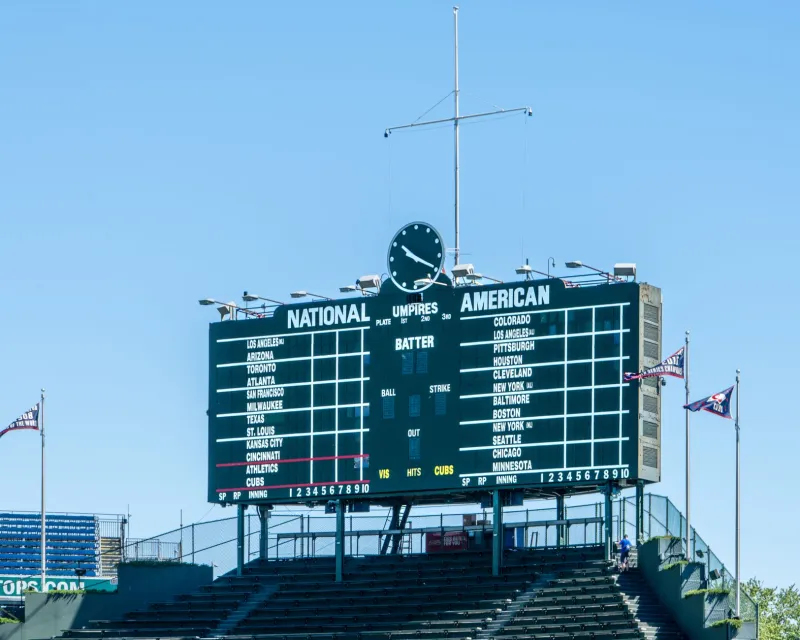
The practice wasn't just for statisticians or obsessives. Ordinary fans kept score because ordinary fans needed to. The scoreboards of the era were minimal — they showed the inning, the score, maybe the count. They didn't tell you who just came in to pitch, or whether the runner on second had gotten there on a walk or a single. If you wanted to follow the game in any real depth, you tracked it yourself.
The notation system that developed over the decades was elegant in its own way. Every defensive position had a number: pitcher was 1, catcher was 2, first baseman was 3, and so on around the diamond to the outfield. A ground ball to shortstop thrown to first was a 6-3. A double play that went third to second to first was a 5-4-3. A strikeout was a K — swinging — or a backward K if the batter went down looking. Hits got marked with lines indicating which base the runner reached. Home runs got a small diamond with all four bases connected.
Learning the system took a little time. Using it became second nature. And once you understood it, you could read someone else's scorecard from decades earlier and follow every moment of a game you never saw.
What Keeping Score Did to the Fan
Here's the thing that gets lost in nostalgia for the scorecard: it wasn't just a record-keeping tool. It was an attention device.
To keep an accurate scorecard, you had to watch every pitch. You had to know who was at the plate, who was on base, and what the count was at all times. You had to track substitutions — who came in for whom and when. You had to notice things that casual observation might miss: the infield shift, the pitch-out, the moment a manager decided to go to the bullpen.
Keeping score turned a passive spectator into something closer to an active participant. You weren't just watching the game unfold. You were processing it, categorizing it, making decisions about how to represent it on paper. That level of engagement changed the experience of being at the ballpark in ways that are genuinely hard to replicate.
Talk to fans who grew up keeping score in the 1950s and '60s, and a common theme emerges: they remember specific games in unusual detail. They remember the at-bat where the cleanup hitter grounded into a double play to end a rally, because they had to write it down. They remember the relief pitcher who came in with two outs in the seventh, because they tracked his entry in the lineup section. The scorecard forced the memory to form.
The Technology That Made It Unnecessary
The decline of personal scorekeeping didn't happen overnight, but it tracked fairly closely with the rise of stadium technology through the 1980s and '90s. As scoreboards got bigger and more sophisticated, the information gap that personal scorecards had filled began to close.
By the time video boards became standard in major league parks, the boards were already displaying pitch speed, batting averages, defensive alignments, and instant replays. By the mid-2000s, in-stadium apps could tell you the count, the outs, the defensive positioning, and the statistical probability of the next pitch type — all in real time, all without lifting a pencil.
The scorecard didn't disappear entirely. You can still buy one at most ballparks. A dedicated subset of fans still fills them out, and they're treated with a certain reverence — the way people look at someone reading a physical book on a subway car, a little surprised, a little impressed. But the mass practice of keeping score, the thing that once connected tens of thousands of fans across the stands on any given afternoon, faded into a niche hobby.
What Went With It
What the scorecard represented — beyond the notations and the pencil marks — was a particular relationship between a fan and a game. It was a relationship built on paying attention. Not passive consumption, not distracted glancing between phone checks, but genuine, sustained, structured attention.
Modern stadium experiences are engineered for entertainment in a broad sense. There are promotions between innings, music during pitching changes, trivia contests on the big board, and a constant stream of stimulation designed to keep every moment of your time at the park filled with something. It's a different kind of experience — louder, more varied, less demanding.
But something was traded away in that exchange. The fan who kept score wasn't just recording the game. They were building a relationship with it, inning by inning, in their own hand.
There's a reason those old scorecards feel like artifacts worth keeping. They're not just records of games. They're records of attention — proof that someone sat in a particular seat on a particular afternoon and decided, with pencil in hand, that this was worth following all the way to the final out.