The Kid With the Number Boards: How Baseball Scoreboards Went From Muscle to Megapixel

Somewhere in the middle innings of a summer afternoon game in 1937, a teenager climbed a ladder inside the left-field wall at a ballpark in the American Midwest. He carried a painted wooden panel with the number three on it. He slotted it into a frame, stepped back down, and the crowd — without any announcement, without any animation or sound effect — simply looked up, registered the update, and returned to watching the game.
That was it. That was the scoreboard.
No HD replay of the double that scored the run. No sponsored graphic celebrating the RBI. No real-time batting average hovering beneath the player's name. Just a number, hung by a kid on a ladder, telling you what you needed to know.
The Original Information System
Hand-operated scoreboards were the backbone of American baseball's visual experience for the better part of a century. The designs varied — some used numbered panels that slid into channels, others relied on workers inside a scoreboard structure who pushed painted boards through slots to face the crowd — but the principle was the same everywhere. Human beings updated scores manually, in real time, visible to everyone in the park.
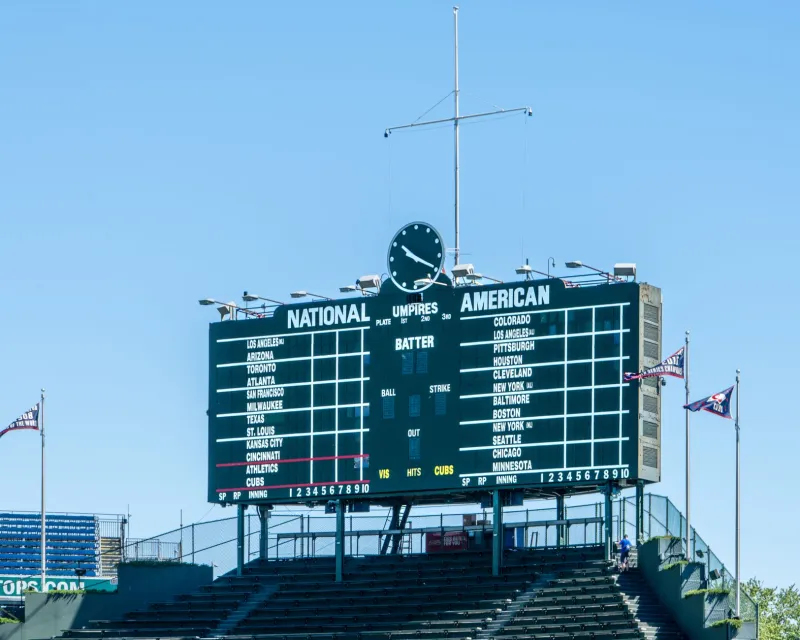
The role of scoreboard operator was typically filled by young men, often teenagers, who worked for minimal wages and navigated cramped, hot interiors behind the outfield wall. At Wrigley Field in Chicago, the hand-operated scoreboard has never been replaced — it still runs on the same basic principle it did when it was installed in 1937, making it the last manually operated scoreboard in Major League Baseball. Workers inside the structure still change innings and scores by hand, still receive pitch-by-pitch information via a telegraph-style system, and still give the ballpark a quality that no LED display has managed to replicate.
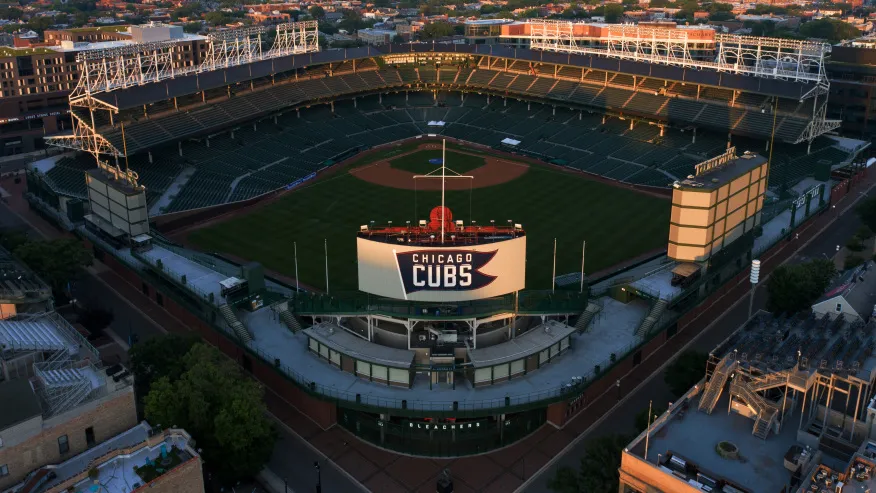 Photo: Wrigley Field, via www.centralillinoisproud.com
But Wrigley is the exception, not the rule. Everywhere else, the kid with the ladder is long gone.
The First Upgrades Were Still Pretty Humble
Electronic scoreboards began appearing in major league parks during the 1950s and '60s, though early versions were modest by any modern standard. The first generation of electric boards could display numbers illuminated by bulbs — a step up from painted panels, but still limited to basic information. Scores, innings, balls and strikes. Nothing more.
The real turning point came in 1980, when the Kansas City Royals unveiled what was then considered a revolutionary installation at Kauffman Stadium: a large video scoreboard capable of displaying animated graphics and, eventually, replays. It wasn't just a scoreboard anymore — it was a screen. The game inside the park now had a television component, and fans could watch what had just happened from a new angle, on a display towering above the outfield.
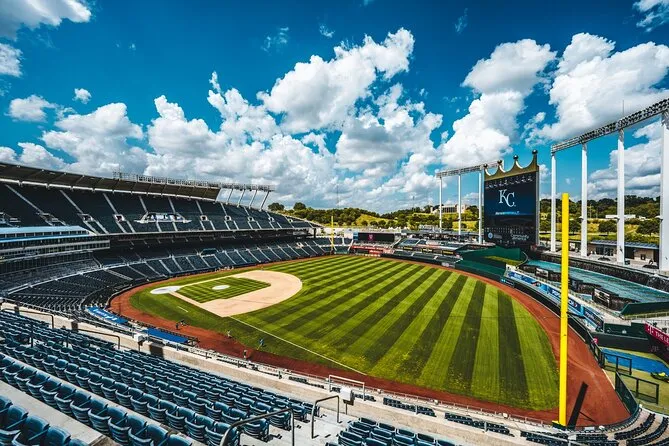 Photo: Kauffman Stadium, via media.tacdn.com
That moment changed everything about what a scoreboard was expected to do.
From Screen to Entertainment Platform
Today's stadium video boards are not scoreboards in any traditional sense of the word. They are entertainment platforms that happen to include a score. The centerfield display at Globe Life Field in Arlington, home of the Texas Rangers, measures over 26,000 square feet. It shows live game footage, multi-angle replays, in-game statistics updated pitch by pitch, player biographical information, sponsored animations, fan cam segments, trivia contests, and promotional content — all simultaneously, in 4K resolution.
 Photo: Globe Life Field, via s3.amazonaws.com
The information density alone would be incomprehensible to a fan from the 1940s. During a single at-bat, today's scoreboard might display the batter's current season average, his career stats against the pitcher he's facing, the pitch velocity and spin rate of the last delivery, a sponsored graphic, and a countdown clock for a between-inning promotion. And that's before the replay queue starts.
Operations behind modern scoreboards involve full production teams — directors, editors, graphic designers, and broadcast technicians — running what is essentially a live television broadcast visible only inside the stadium. The kid with the ladder has been replaced by a crew of twenty people in a production suite who trained for this job.
The Quiet Argument for the Old Way
Here's the thing that's worth sitting with: the hand-operated scoreboard required something of the fan. You had to pay attention. You had to look up at the right moment to catch the update. You had to carry the game in your head — remembering the score from inning to inning, tracking the action without a screen narrating it back to you.
That experience created a different kind of engagement. Fans at old ballparks weren't passive consumers of a curated entertainment product. They were active participants in assembling the story of the game from available evidence. The scoreboard was a tool, not a show.
Nobody seriously argues that we should go back — the modern in-stadium experience is richer, more accessible, and more entertaining by almost every measurable standard. But there's a reason Wrigley Field's manual scoreboard is treated as something close to sacred. It connects the modern game to a version of itself that felt less produced, less mediated, more raw.
The number three, hung by a kid on a ladder, told you everything you needed to know. Whether it told you enough is a different question entirely.
What the Scoreboard Tells Us About the Game
The evolution of the ballpark scoreboard tracks almost perfectly with the broader transformation of professional sports into entertainment industry. Each upgrade — from hand panels to electric bulbs to video screens to 4K production suites — reflects a sport that was learning, decade by decade, that it was competing for attention against everything else in American culture.
The modern scoreboard doesn't just display the game. It sells it, packages it, and delivers it in a format designed to hold your attention against the pull of the phone in your pocket. That's not a criticism — it's a survival strategy. But it does mean that something genuinely irreplaceable disappeared the day the last kid climbed the last ladder in the last outfield wall.
Somewhere in a Chicago ballpark, though, that kid is still climbing. And the crowd still looks up.